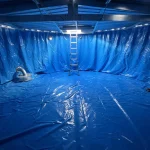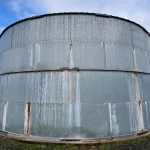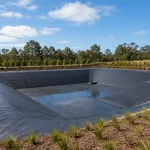
A tank liner used for drinking water has a different purpose from a general containment liner. It must provide reliable water containment, but that is only part of the requirement. Materials that come into contact with potable water also need to be suitable for that application.
This distinction matters because not every waterproof liner is automatically suitable for drinking water. Potable water tank liners can be used in steel, concrete, sectional, and other water storage tanks. They may be installed during tank construction or used when an existing tank requires relining.
The correct liner depends on the tank structure, stored water, operating conditions, material compatibility, and applicable drinking-water requirements.
In Australia, material selection should also consider requirements and guidance relating to products used in contact with drinking water. The Australian Drinking Water Guidelines state that materials used in water systems should be suitable for drinking water, and reference AS/NZS 4020 for products in contact with drinking water.
This guide explains how potable water tank liners work, how they differ from other liners, what materials may be used, the standards to consider, and what to check before selecting, repairing, or replacing a liner.
What is a Potable Water Tank Liner?
A potable water tank liner is an internal containment membrane intended for a tank that stores drinking water. The liner creates a barrier between the stored water and the underlying tank structure.
Depending on the tank, the underlying structure may be:
- steel;
- concrete;
- galvanised steel;
- sectional panels;
- another suitable structural substrate.
The liner itself does not normally provide the primary structural strength of the tank. Instead, it provides the containment layer. This distinction is important.
A liner can address containment requirements, but it should not be used to hide serious structural deterioration. If the tank walls, floor, supports, or other structural components are damaged, those conditions need to be assessed separately.
Why are Liners Used in Potable Water Tanks?
There are several reasons a drinking water tank may use an internal liner.
Water Containment
The most obvious purpose is to retain stored water. A flexible membrane can provide a continuous containment barrier across the internal tank surface.
Separation From the Tank Structure
A liner separates the water from much of the underlying substrate. This can be useful in tanks where direct contact between stored water and the structural material is not desirable.
Tank Refurbishment
An existing tank may remain structurally serviceable while its original internal containment system has deteriorated. In suitable cases, installing a new liner can form part of a refurbishment strategy.
Leak Management
Where an existing liner has failed, repair or replacement may restore containment. However, the source of the leak should first be identified.
Not every water loss problem originates from the liner.
Extending the Useful Life of a Serviceable Tank
Where the structure remains suitable for continued use, relining may allow the tank to remain operational without complete tank replacement.
This should follow an appropriate assessment of the tank condition.
What Makes a Tank Liner Suitable for Drinking Water?
A liner should not be considered suitable for drinking water simply because it is waterproof. Potable-water applications require consideration of the material’s intended use in contact with drinking water.
Several factors matter.
Material Formulation
Different liners can contain different polymers, additives, reinforcement systems, and other components. Two membranes that appear similar may have very different intended applications.
Drinking-Water Contact Suitability
The specific product should be suitable for its intended contact with potable water. This is different from simply being suitable for general water storage.
Temperature
The liner must be appropriate for the temperatures expected during service. Temperature can affect both material performance and suitability.
Water Chemistry
Water chemistry can influence liner selection and long-term performance. The liner should be compatible with the water and expected treatment conditions.
Seams and Connections
A potable water liner is more than a large sheet of membrane. Seams, penetrations, fittings, and other details can influence the performance of the completed system.
Installation
Even an appropriate material can perform poorly if it is incorrectly installed. Preparation, fitting, seams, penetrations, and attachment details all need to be properly managed.
How are Potable Water Tank Liners Different from other Tank Liners?
The main difference is the intended application. Tank liners are used for many different liquids and storage conditions. A material suitable for one application should not automatically be assumed suitable for another.
| Consideration | Potable Water Tank Liners | Non-Potable Tank Liners |
|---|---|---|
| Primary application | Drinking water storage | Fire, process, industrial or other storage |
| Water-contact suitability | Critical | Depends on application |
| Material selection | Must consider potable-water use | Based on stored liquid and conditions |
| Testing requirements | Drinking-water requirements may apply | Application dependent |
| Chemical compatibility | Important | Important |
| Repair materials | Must remain appropriate for potable-water application | Selected for relevant application |
| Cleaning | Must consider drinking-water use | Depends on stored liquid |
The key point is simple: A liner that can hold water is not automatically a potable water tank liner. The material needs to be appropriate for the actual application.
For larger drinking water storage applications, commercial tank liners can provide a tailored containment solution based on tank design, stored water requirements, and operating conditions.
Potable Water Liners vs Fire Water Tank Liners
Potable and fire water tanks can both store large quantities of water, but they serve different purposes. Potable tanks store water intended for human consumption. Fire water tanks store a dedicated water supply for fire protection systems.
As a result, liner selection is based on different application requirements. A membrane designed for fire water containment should not automatically be assumed suitable for drinking-water contact.
Likewise, the fact that a liner performs well in a potable tank does not mean it is automatically the optimum specification for every fire water tank. Material selection should always begin with the tank’s intended use.
Potable Water Liners vs Process Water Liners
Process water can vary enormously between industrial applications.
It may contain:
- dissolved minerals;
- treatment chemicals;
- elevated concentrations of particular substances;
- different pH conditions;
- process contaminants.
As a result, process water tank liners are usually selected according to the chemistry and operating conditions of the particular process. Potable water liners have an additional concern: materials in contact with the stored water must be suitable for a drinking-water application.
The terms should therefore not be used interchangeably.
Potable Water Liners vs Chemical Containment Liners
Chemical containment creates another important distinction. A liner may have excellent resistance to a particular industrial chemical but still not be intended for potable-water use.
Likewise, a potable-water liner may not provide the chemical resistance required for a specialised industrial storage application. This illustrates why phrases such as “food grade”, “chemical resistant”, “waterproof”, and “potable water suitable” should not automatically be treated as equivalent.
The correct material depends on what is being stored and the requirements of that application.
What Standards Apply to Potable Water Tank Liners in Australia?
Australian potable-water applications require particular attention to materials that come into contact with drinking water. One of the key references is AS/NZS 4020:2018, Testing of products for use in contact with drinking water.
Standards Australia describes AS/NZS 4020:2018 as addressing products that come into contact with drinking water and providing testing related to their effect on water quality.
The Australian Drinking Water Guidelines (ADWG) are also important. They provide the national framework for managing drinking-water quality and state that materials used in water systems should be suitable for use with drinking water. The Guidelines reference AS/NZS 4020 in relation to materials in contact with drinking water.
However, the ADWG themselves are guidelines rather than a single nationally enforceable law. NHMRC notes that implementation is determined by individual Australian states and territories.
Therefore, a potable tank project may need to consider:
- AS/NZS 4020;
- the Australian Drinking Water Guidelines;
- state or territory requirements;
- project specifications;
- water authority requirements;
- other standards or regulations applicable to the particular tank and installation.
The exact requirements should be confirmed for the project rather than assuming one standard covers every aspect of the tank.
What is AS/NZS 4020?
AS/NZS 4020 concerns products intended for use in contact with drinking water. Its role is particularly relevant because a material can physically contain water while still potentially affecting its quality.
Standards Australia explains that the standard provides a way to test products used in drinking-water applications and assess their expected performance in relation to water quality.
For tank liners, this means potable-water suitability needs to be considered at the product/material level, rather than assuming an entire category of membrane is automatically appropriate.
For example, describing a liner simply as “PVC” does not establish its suitability for drinking water. The specific liner product and supporting documentation matter.
Why Does Drinking-Water Contact Testing Matter?
A potable water liner remains in direct contact with stored water, potentially for extended periods. The concern is therefore not only whether the membrane leaks. Materials in a drinking-water system should not adversely affect water quality beyond applicable requirements.
The Australian Drinking Water Guidelines specifically identify the suitability of materials and chemicals used in water systems as part of drinking-water management. This is one of the major differences between potable water liners and general-purpose containment membranes.
Physical durability matters. Water-contact suitability matters too.
Does AS/NZS 4020 Mean the Entire Tank is Compliant?
This distinction is worth making. Evidence relating to a liner material or product under AS/NZS 4020 should not automatically be interpreted as proof that an entire installed tank complies with every requirement relevant to potable water storage.
A complete tank can contain many components, including:
- the liner;
- fittings;
- seals;
- penetrations;
- pipe connections;
- valves;
- repair materials;
- sealants;
- other water-contact components.
The tank may also be subject to design, installation, water quality, maintenance, and jurisdiction-specific requirements. Product documentation should therefore be checked carefully rather than relying on a broad statement such as “potable approved”.
What Materials are Used for Potable Water Tank Liners?
Flexible tank liners can be manufactured from different membrane systems. The appropriate choice depends on the tank and the intended application.
Rather than selecting a liner solely by polymer name, it is important to consider the specific product formulation and its documented suitability.
PVC Tank Liners
PVC is used for many flexible containment applications. Its advantages can include flexibility, fabrication options, and suitability for custom liner construction.
However, not every PVC formulation is intended for drinking-water contact. A PVC membrane designed for an industrial containment application should not automatically be substituted for a potable-water liner.
Reinforced Flexible Membranes
Some liner systems incorporate reinforcement to provide additional dimensional stability or mechanical performance. The reinforcement and overall membrane construction need to suit the tank geometry and expected operating conditions.
Again, potable-water suitability needs to apply to the specific product being installed.
Other Liner Materials
Other polymeric membrane systems may also be used depending on the application.
Material selection should consider:
- water-contact suitability;
- expected water chemistry;
- temperature;
- tank dimensions;
- substrate;
- mechanical requirements;
- installation method;
- expected service conditions.
There is no single membrane material that is automatically best for every potable water tank.
Are PVC Tank Liners Safe for Drinking Water?
Some PVC liner products can be suitable for potable-water applications. But not all PVC liners are suitable for drinking water. This distinction is critical.
PVC describes a broad material family. Different products can use different formulations and additives and can be manufactured for completely different purposes.
Therefore, the correct question is not:
“Is PVC safe for drinking water?”
It is:
“Is this specific PVC liner product suitable and appropriately documented for this potable-water application?”
Product documentation should be reviewed before selection. Where Australian drinking-water contact requirements apply, relevant AS/NZS 4020 documentation should also be considered.
What Documentation Should be Checked Before Selecting a Potable Water Liner?
Documentation can help confirm whether the proposed material matches the intended application.
Depending on the project, useful information may include:
- product data sheets;
- manufacturer specifications;
- intended-use statements;
- relevant test reports;
- AS/NZS 4020 information where applicable;
- temperature limitations;
- chemical compatibility information;
- installation requirements;
- warranty conditions;
- maintenance limitations.
The details matter. For example, documentation for one membrane formulation should not automatically be assumed to cover another visually similar product. The same principle applies to replacement and repair materials.
What Types of Tanks can use Potable Water Liners?
Flexible potable water liners can potentially be used with several tank construction types. Suitability depends on the tank structure and liner system.
Steel Water Tanks
A liner can separate stored water from the underlying steel surface. However, corrosion and structural deterioration should still be assessed.
Installing a liner does not make significant steel deterioration irrelevant.
Concrete Water Tanks
Concrete tanks can develop cracking, surface deterioration, joint problems, or leakage. A liner may provide a containment barrier where the structure remains suitable.
The substrate should still be assessed before installation.
Panel and Sectional Tanks
Sectional tanks are assembled from individual panels and contain numerous joints and connections. A flexible liner can provide an internal containment system independent of many panel joints.
The tank structure, fasteners, internal supports, and substrate still need to remain suitable for service.
Rural Water Tanks
Potable liners may also be relevant for rural tanks where stored water is intended for drinking purposes. The same principle applies: the liner should be selected for potable-water contact rather than simply general water containment.
Water Towers and Large Storage Tanks
Lining systems may also be used in larger drinking-water storage structures. Tank geometry, access, pressure conditions, installation logistics, and project-specific requirements become increasingly important as tank size and complexity increase.
Material selection, tank size, preparation, and installation requirements can all affect project pricing; our tank liner cost guide explains the main factors that influence tank liner costs in Australia.
Can an Existing Water Tank be Relined for Potable Water?
In many cases, an existing tank can potentially be relined rather than completely replaced. However, relining should follow a condition assessment.
The existing tank needs to provide a suitable structure for the new containment system.
Before relining, relevant areas may include:
- tank walls;
- floor;
- roof;
- panel condition;
- corrosion;
- structural supports;
- bolts and fasteners;
- penetrations;
- previous repairs;
- existing liner condition.
This is particularly important when an old liner has been hiding the underlying tank surface. Removing it may reveal corrosion or deterioration that was previously inaccessible.
For potable water applications, professional tank liner installation services can help ensure the selected liner is correctly fitted around seams, penetrations, fittings, and other critical tank details.
What are the Signs a Potable Water Tank Liner needs Attention?
Liner deterioration can appear in several ways.
Possible warning signs include:
- unexplained water loss;
- visible punctures;
- tears;
- damaged seams;
- cracking;
- brittle areas;
- wrinkles or movement;
- deterioration around penetrations;
- damaged attachment points;
- recurring repairs;
- visible ageing;
- separation or distortion.
Not every defect means the complete liner needs replacement. A local puncture may require a different response from widespread material deterioration.
The first step is to establish the location, cause, and extent of the problem.
How are Potable Water Tank Liners Inspected?
Liner inspection should focus on areas where damage, movement, or leakage is most likely to develop.
Depending on access and tank condition, an assessment may consider:
- membrane surfaces;
- seams;
- corners;
- penetrations;
- fittings;
- attachment points;
- floor areas;
- previous repairs;
- visible deformation;
- signs of leakage.
The underlying tank condition should also be considered where accessible. This is important because apparent liner problems can sometimes be associated with movement, corrosion, sharp substrate defects, or deterioration elsewhere in the tank.
Can a Potable Water Tank Liner be Repaired?
Some liner damage can be repaired. Whether repair is appropriate depends on the condition of the surrounding membrane.
A local repair may be reasonable where:
- damage is isolated;
- the remaining membrane is in good condition;
- the cause has been identified;
- a compatible repair system is available.
Repair becomes less attractive when deterioration is widespread. Multiple old repairs, brittle material, extensive seam deterioration, or recurring leaks may indicate that replacement should be considered.
Do Potable Water Liner Repairs need Compatible Materials?
Yes. Repair material selection deserves the same care as the original liner selection. Using a potable-water liner and then repairing it with an unsuitable patch, adhesive, sealant, or other material can undermine the original material-selection approach.
Where components will remain in contact with drinking water, their suitability for that application should be considered. The Australian Drinking Water Guidelines emphasise that materials used in water systems should be suitable for drinking-water use.
This means maintenance teams should avoid selecting repair materials solely because they bond well or appear physically compatible. Documentation for the repair system matters too.
When Should a Potable Water Tank Liner be Replaced?
Replacement may become more appropriate when local repairs can no longer provide a practical solution.
Possible indicators include:
- widespread material deterioration;
- repeated leakage;
- multiple failed repairs;
- extensive seam problems;
- brittle or degraded membrane;
- widespread mechanical damage;
- deterioration around numerous penetrations;
- unsuitable existing liner material;
- significant ageing across the system.
Replacement decisions should also consider the tank itself. If the supporting structure has serious deterioration, replacing only the liner may not address the main problem.
This is why liner replacement and structural tank assessment often need to be considered together.
Does a Tank need to be Cleaned Before Installing a New Liner?
Proper preparation is important before relining. Sediment, corrosion products, old coating fragments, debris, and other material may need to be removed so that the underlying condition can be assessed.
Cleaning also makes it easier to identify:
- corrosion;
- sharp projections;
- damaged surfaces;
- old repairs;
- structural defects;
- contamination;
- deterioration around penetrations.
Simply covering a dirty or deteriorated substrate with a new membrane can leave important problems unresolved. The required cleaning method depends on tank material, existing condition, contamination, and the proposed liner system.
How Long do Potable Water Tank Liners Last?
There is no useful universal service-life figure for every potable water tank liner. Performance depends on several interacting factors.
These include:
- liner material;
- product formulation;
- installation quality;
- water chemistry;
- temperature;
- tank movement;
- substrate condition;
- mechanical damage;
- cleaning methods;
- maintenance;
- inspection frequency;
- operating environment.
A liner that remains undamaged in favourable conditions may perform very differently from the same type of membrane exposed to poor installation details or unsuitable operating conditions. Condition-based inspection is therefore more useful than assuming replacement is required after a fixed number of years.
Potable Water Liners for Concrete Tanks
Concrete tanks create particular lining considerations.
Concrete surfaces can experience:
- cracking;
- joint movement;
- surface deterioration;
- rough areas;
- previous repair defects;
- water ingress or leakage.
The liner can provide the water containment barrier, but it does not eliminate the need to understand the concrete condition. Significant cracks or structural movement should be assessed before lining.
Surface preparation is also important because rough or damaged areas may affect the membrane. A protective layer or other preparation may be required depending on the liner system.
Potable Water Liners for Steel and Panel Tanks
Steel and sectional tanks have different considerations. Corrosion is particularly important. An internal liner may separate stored water from the structural tank material, but external corrosion and hidden structural deterioration can still occur.
Panel tanks also contain numerous connections.
Areas that may require assessment include:
- panel surfaces;
- bolts;
- joints;
- internal supports;
- floor connections;
- roof supports;
- penetrations;
- previous repairs.
Where corrosion is discovered during relining work, its extent should be established before the new membrane is installed.
Potable Water Liners vs Stainless Steel Water Storage
A liner is not the only approach to managing water contact inside a storage tank. Some tanks use materials such as stainless steel as part of their containment system.
The choice between a lined tank and another construction type depends on factors including:
- water chemistry;
- required capacity;
- tank configuration;
- site access;
- corrosion environment;
- initial cost;
- maintenance;
- inspection;
- expected service conditions.
Neither approach should be selected solely because one material sounds more durable. The entire storage system needs to be appropriate for the intended water and operating environment.
Are “Food Grade” and “Potable Water Suitable” the Same thing?
These terms should not automatically be treated as interchangeable. “Food grade” can be used in different contexts and does not, by itself, establish that a particular liner has the required documentation for a specific drinking-water application.
Likewise, marketing terms should not replace product-specific technical information.
For potable-water storage, the safer approach is to verify:
- the exact product;
- intended use;
- relevant drinking-water contact testing;
- applicable standards;
- project requirements.
This avoids relying on broad descriptions that may mean different things between manufacturers.
What Should You Consider when Choosing a Potable Water Tank Liner?
Selecting a liner should involve more than comparing membrane thickness or price.
The main considerations include:
- suitability for potable-water contact;
- relevant standards and documentation;
- tank material;
- tank dimensions;
- water chemistry;
- operating temperature;
- liner material and construction;
- condition of the existing tank;
- penetrations and fittings;
- installation method;
- substrate preparation;
- inspection access;
- cleaning requirements;
- repair compatibility;
- local regulatory requirements.
For Australian projects, the Australian Drinking Water Guidelines and relevant AS/NZS 4020 requirements should be considered alongside applicable state, territory, water authority, and project-specific requirements.
The lowest-cost membrane is not necessarily the lowest-cost solution over the life of the tank. Likewise, the most expensive material is not automatically the best choice.
The objective is to match the liner system to the water, tank, environment, and applicable requirements.
Key Takeaways
Potable water tank liners provide a containment barrier for tanks storing drinking water, but their role extends beyond simply preventing leaks. The material must be suitable for its intended drinking-water application.
This is the key distinction between potable liners and many fire water, process water, industrial, or chemical containment liners. In Australia, AS/NZS 4020 is an important reference for products used in contact with drinking water. The Australian Drinking Water Guidelines also state that materials used in water systems should be suitable for drinking-water use.
Not every PVC liner is suitable for drinking water, and terms such as “waterproof” or “food grade” should not replace product-specific documentation.
Existing tanks should also be assessed before relining. A new membrane can restore containment in an otherwise suitable tank, but it should not be used to conceal structural corrosion, cracking, or other significant deterioration.