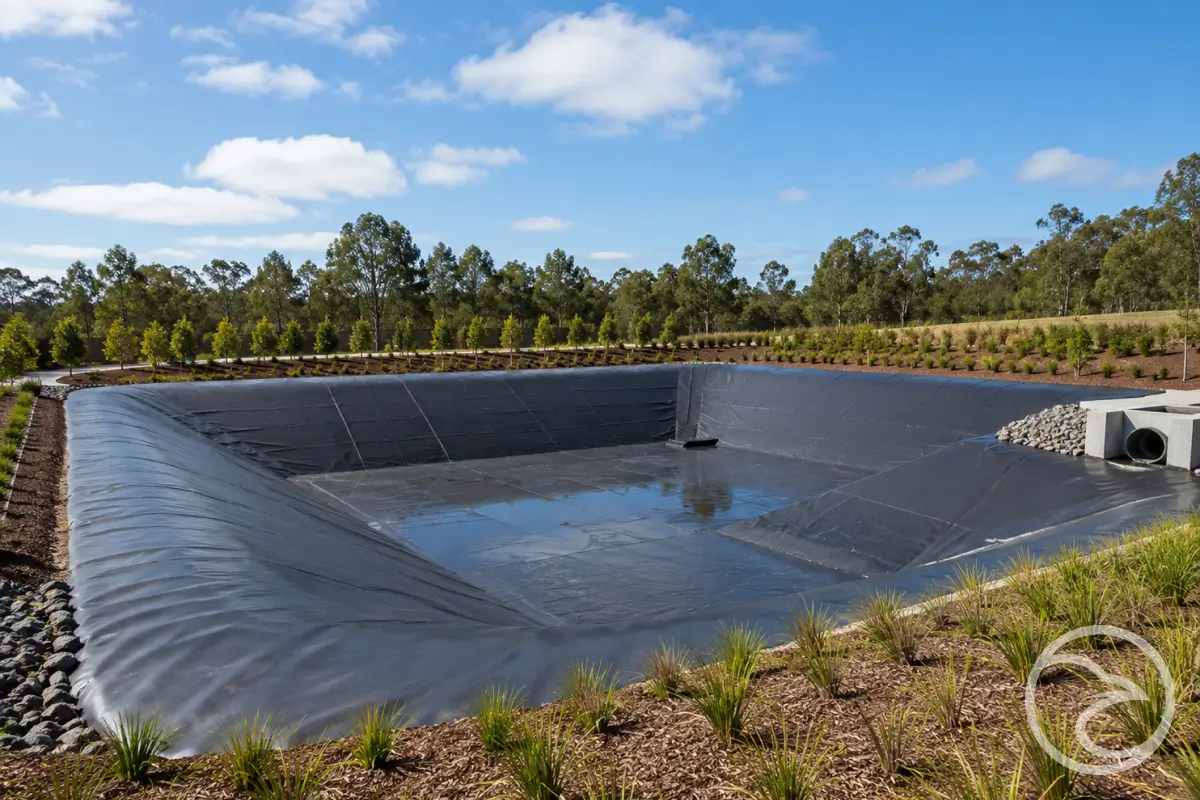
Water containment is an important part of agriculture, industry, stormwater management, mining, landscaping, and infrastructure. However, storing water in an excavated dam or pond is not always as simple as creating a basin. Water can gradually escape through permeable soil, cracks, weak ground layers, or poorly sealed surfaces.
This is where dam and pond liners play an important role. A liner creates a controlled barrier between stored water and the surrounding ground. It can reduce seepage, protect nearby soil, improve water retention, and support environmental management requirements.
Different applications require different lining systems. A farm dam may have very different requirements from a bioretention system or industrial retention pond. Material selection must therefore consider water quality, ground conditions, chemicals, UV exposure, expected lifespan, and local requirements.
This guide explains how dam liners, pond liners, bioretention liners, and retention pond lining systems work. It also covers common materials, applications, Australian requirements, maintenance, selection, and inspections.
What are Dam and Pond Liners?
Dam and pond liners are barriers installed within water containment structures. Dam and pond liners are barriers installed within water containment structures.
Their main purpose is to control movement of water between the structure and surrounding ground. Many modern lining systems use a flexible geomembrane.
Geomembranes are polymeric sheets designed to provide a very low-permeability barrier in civil and environmental applications. Depending on the application, a lining system can include several components.
These may include:
- Geomembrane liner
- Protective geotextile
- Prepared subgrade
- Drainage layers
- Geosynthetic clay liner
- Anchor trenches
- Protective soil layers
The exact construction depends on site conditions and the purpose of the containment area. A simple irrigation pond may only require a suitable membrane and prepared base.
Industrial or environmental containment can require a more complex engineered lining system.
What is the Purpose of a Water Containment Liner?
The primary function of a liner is simple: keep water where it is supposed to be. However, liners can perform several additional functions.
A properly designed lining system can:
- Reduce water losses through seepage
- Improve storage efficiency
- Protect groundwater
- Reduce interaction between stored liquids and soil
- Support environmental management
- Help control contaminated or nutrient-rich water
- Improve predictability of water storage
- Protect surrounding land
- Support long-term operation of containment infrastructure
The importance of each function depends on the application. For agricultural water storage, preventing water loss may be the main priority.
For wastewater or industrial ponds, environmental protection may be more important.
What are Dam Liners?
A dam liner is an impermeable or low-permeability barrier used within a dam or reservoir. Dam liners are commonly used when natural soil cannot provide reliable water retention. Some soils naturally contain enough clay to limit seepage.
Other sites contain sand, gravel, fractured rock, or highly permeable soil. Water losses can become significant under these conditions. A dam lining system creates an additional barrier between stored water and the underlying ground.
The liner can cover the base, slopes, or the entire internal surface.
Where are Dam Liners Used?
Dam liners can be used across many Australian industries and properties.
Common applications include:
- Farm dams
- Irrigation dams
- Agricultural reservoirs
- Rural water storage
- Mining water storage
- Process water dams
- Wastewater containment
- Industrial storage ponds
- Aquaculture
- Emergency water storage
- Large commercial water reservoirs
The required liner specification depends heavily on what the dam will contain. Clean irrigation water has different requirements from wastewater or industrial process water.
Visit our dam liners page to learn more about durable lining solutions for water storage and containment applications.
Benefits of Dam Liners
One major benefit of dam lining is improved water retention. Reducing seepage helps preserve stored water during dry periods.
This can be particularly valuable where water availability is limited.
Other potential benefits include:
- Reduced seepage losses
- More reliable storage capacity
- Better protection of surrounding soil
- Improved groundwater protection
- Easier water management
- Suitability for difficult ground conditions
- Long service life with appropriate materials
- Compatibility with large containment areas
A dam liner can also make a previously unsuitable site more practical for water storage. However, the liner must match the site’s conditions.
Simply choosing the thickest membrane does not automatically create the best system.
What are Pond Liners?
A pond liner performs a similar function on a generally smaller containment structure. It creates a barrier that prevents water from escaping through the pond base and walls.
Pond liners are used for both decorative and functional water storage. They can be installed during new construction or during pond rehabilitation.
Common Pond Liner Applications
Pond lining systems are used for:
- Landscape ponds
- Farm ponds
- Irrigation ponds
- Aquaculture ponds
- Golf course ponds
- Commercial landscaping
- Stormwater ponds
- Wastewater ponds
- Industrial ponds
- Water treatment infrastructure
- Sediment ponds
Not every pond needs the same liner. A decorative pond has different requirements from an industrial containment pond. The water chemistry, operating conditions, location, and environmental risks must all be considered.
Visit our pond liners page to explore durable lining solutions for ponds and other water containment applications.
Benefits of Pond Liners
A correctly selected pond lining membrane provides greater control over water movement. This is useful when natural ground conditions cannot retain water reliably.
Other advantages can include:
- Reduced water loss
- Protection against groundwater interaction
- Better containment of wastewater
- Flexible pond shapes
- Easier integration into new construction
- Compatibility with different pond sizes
- Long-term water containment
The liner also separates stored water from potentially unsuitable ground materials. This can be important for sensitive water uses.
Dam Liners vs Pond Liners
Dam liners and pond liners have the same fundamental purpose. Both create a barrier to control seepage. The difference usually comes from the scale, design, operating conditions, and application.
Dam lining projects are often larger and may involve significant water pressure. They can require detailed engineering around slopes, anchoring, drainage, and membrane movement. Pond liners may cover smaller areas, but their requirements can still be demanding.
Industrial ponds, for example, may contain liquids requiring high chemical resistance. Therefore, the name of the structure should not determine the liner specification.
Site conditions and performance requirements should determine the lining system.
What is a Bioretention Liner?
Bioretention systems are designed to manage stormwater runoff. They often use vegetation, engineered filter media, drainage layers, and other components to manage water. A bioretention liner may be included when water movement into surrounding soil needs additional control.
The liner can help separate the bioretention system from nearby soil or infrastructure. However, not every bioretention system should be completely impermeable. Some systems are specifically designed to encourage infiltration.
Others need restricted or controlled infiltration.
The appropriate design depends on:
- Local soil conditions
- Groundwater
- Nearby buildings
- Underground infrastructure
- Stormwater quality
- Site contamination
- Drainage requirements
- Local authority requirements
Bioretention lining should therefore form part of the overall stormwater design. It should not be treated as an isolated component. For bioretention and stormwater management projects, explore our dam and pond liners for bioretention basins for suitable lining solutions.
Where are Bioretention Liners Used?
Bioretention systems can be found within:
- Residential developments
- Commercial developments
- Car parks
- Industrial areas
- Public spaces
- Urban drainage systems
- Infrastructure projects
Their purpose is generally connected to stormwater management and water quality. Australian stormwater guidance supports integrated management at catchment, waterway, and development levels. Project-specific requirements should still be checked with the relevant local or state authority.
What is Retention Pond Lining?
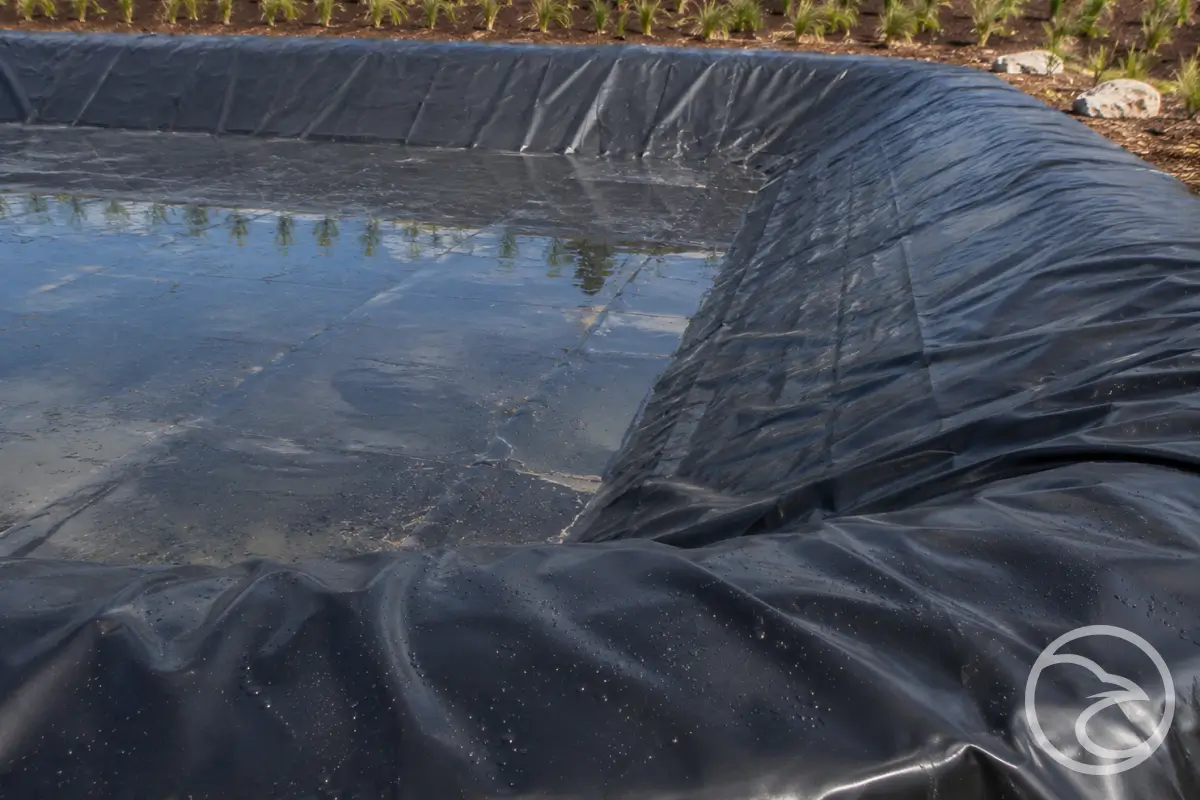
A retention pond is designed to hold stormwater or other water for extended periods. Unlike temporary drainage areas, these ponds may maintain a permanent water volume. A retention pond liner helps control seepage through the pond base and sides.
The lining system can also help separate retained water from surrounding soils. This becomes particularly important where the stored water may contain pollutants.
Retention Pond Lining Applications
Retention pond lining can be used within:
- Urban stormwater systems
- Commercial developments
- Industrial facilities
- Road infrastructure
- Large residential developments
- Water treatment facilities
- Agricultural sites
- Mining operations
The required level of containment depends on the water being stored. A stormwater retention pond may have different specifications from an industrial retention basin.
Benefits of Retention Pond Liners
Retention pond liners can provide several practical and environmental benefits.
These include:
- Controlled seepage
- More predictable water levels
- Reduced groundwater interaction
- Protection of surrounding soil
- Improved containment of polluted water
- Greater control over stormwater systems
- Support for environmental management plans
Synthetic liners are particularly important when stored materials could affect sensitive water resources. For example, Western Australian guidance provides specific management measures for synthetic liners used in potentially polluting containment structures.
Common Materials for Dam and Pond Liners
Several materials can be used for dam and pond lining. Each material has different properties.
The right option depends on the site rather than one material being universally superior.
HDPE Geomembrane
HDPE liners are commonly considered for:
- Dams
- Wastewater containment
- Large ponds
- Industrial ponds
- Agricultural storage
- Retention ponds
HDPE can be suitable for large installations where durability is important.
LLDPE Geomembrane
Linear low-density polyethylene, or LLDPE, provides greater flexibility than many HDPE products. That flexibility can be useful on irregular surfaces or where some ground movement is expected.
Applications may include:
- Ponds
- Dams
- Landscape water features
- Irregular containment areas
- Certain industrial applications
Material suitability should always be confirmed against project conditions.
PVC Liners
PVC is another flexible lining material. It can be suitable for ponds and selected water containment applications. PVC is often valued for flexibility and its ability to conform to complex shapes.
However, exposure conditions and expected service life should be considered during selection.
EPDM Pond Liners
EPDM is a flexible synthetic rubber material commonly associated with pond applications. Its flexibility can make it useful for complex shapes and smaller water features.
Typical uses include:
- Landscape ponds
- Decorative ponds
- Garden water features
- Selected aquaculture applications
The specific product must still be checked for its intended water use.
Geosynthetic Clay Liners
A geosynthetic clay liner, or GCL, uses a layer of bentonite combined with geotextile components. GCL systems can provide low permeability when correctly designed and installed.
They may be used alone or with other lining components. Australian water infrastructure guidance demonstrates that both geomembranes and GCL systems can form part of engineered pond lining designs.
Clay Liners
Natural or compacted clay can also provide a low-permeability barrier. However, its performance depends heavily on soil properties and installation quality.
lay liners may require substantial thickness and careful compaction. Drying, cracking, settlement, or unsuitable material can affect their performance.
How is the Right Liner Material Selected?
Choosing a liner should start with the application, not the material. Several questions need to be answered first.
1. What Will the Structure Contain?
Clean water, stormwater, wastewater, and industrial liquids have different requirements. Chemical compatibility becomes especially important for industrial applications.
2. What are the Ground Conditions?
Soil characteristics can affect liner selection and preparation. Sharp rocks or uneven ground may increase puncture risks.
Soft ground or settlement may require a more flexible system.
3. How Large is the Structure?
Large dams can create different engineering challenges from small ponds. Slopes, water pressure, anchoring, and membrane movement must be considered.
4. Will the Liner Be Exposed?
Australian conditions can expose liners to strong sunlight and high temperatures. UV exposure should therefore be considered when selecting exposed geomembranes.
5. Is the Water for Drinking Purposes?
Materials contacting drinking water require additional consideration. AS/NZS 4020:2018 addresses testing of products used in contact with drinking water.
Where potable water is involved, appropriate product certification should be confirmed before installation.
6. What is the Environmental Risk?
Containment requirements increase when leakage could affect groundwater, waterways, or sensitive land. Higher-risk applications may require engineered lining and monitoring systems.
Australian Standards, Guidelines and Regulatory Considerations
There is no single Australian rule covering every dam liner and pond liner application.
Requirements depend on:
- State or territory
- Local authority
- Type of water
- Environmental risk
- Project size
- Land use
- Industry
- Drinking water requirements
The Australian and New Zealand Guidelines for Fresh and Marine Water Quality provide a national framework for water quality management. However, local and jurisdiction-specific requirements can take priority over broader guideline values. Projects involving recycled water may also need to consider the Australian Guidelines for Water Recycling.
For drinking water applications, AS/NZS 4020 may apply to materials contacting the stored water. Additional state EPA, water authority, council, or planning requirements may also apply.
For this reason, specifications should be checked for each individual project.
Why Installation Quality Matters
Even a high-quality liner can perform poorly when installation is inadequate. The supporting surface must be suitable before the membrane is placed.
Problems can arise from:
- Sharp stones
- Poorly prepared ground
- Incorrect anchoring
- Damaged seams
- Excessive membrane tension
- Poor drainage
- Inadequate protection layers
- Construction traffic
- Incorrect material handling
Large geomembrane systems also require careful seam construction. The objective is to create a continuous containment barrier across the structure.
Quality assurance should therefore be considered part of the lining system.
Dam and Pond Liner Maintenance
Dam and pond liners generally require limited routine maintenance. However, they should not simply be installed and forgotten.
Regular observation can help identify problems before they become significant.
Maintenance may include checking for:
- Visible liner damage
- Exposed membrane areas
- Unexpected water loss
- Erosion around edges
- Vegetation problems
- Damaged anchor areas
- Changes around penetrations
- Sediment accumulation
- Mechanical damage
The maintenance schedule should reflect the importance of the structure. A decorative pond and an industrial wastewater pond should not have identical maintenance programs.
Factors that can Damage a Liner
Several conditions can reduce liner performance over time.
Common risks include:
- Punctures
- Sharp ground materials
- Construction damage
- UV exposure
- Chemical exposure
- Animal activity
- Root growth
- Ground movement
- Poor anchoring
- Damaged seams
- Excessive settlement
Some problems become visible quickly. Others may only appear through unexplained changes in water levels.
Protecting the liner during installation is therefore just as important as future maintenance.
Dam and Pond Liner Inspections
Inspections help confirm whether a lining system continues to perform as intended. The required inspection frequency depends on the structure and its risk level. A basic inspection can assess accessible areas for visible deterioration or damage.
More detailed inspections may be appropriate when leakage or liner failure is suspected.
Important areas can include:
- Exposed membrane
- Seams
- Edges
- Anchor points
- Inlets and outlets
- Pipe penetrations
- High-stress areas
- Locations showing unexpected water loss
Inspection findings can then guide further testing, maintenance, or repair. For large or critical containment systems, inspections should form part of a planned asset management program.
When Should a Dam or Pond Liner be Considered?
A lining system may be worth considering when a structure cannot reliably retain water naturally. It may also be necessary where uncontrolled seepage creates an environmental risk.
Common warning signs include:
- Continual unexplained water loss
- Highly permeable soil
- Previous seepage problems
- Sensitive groundwater nearby
- Contaminated water storage
- New environmental requirements
- Changing use of an existing pond
- Rehabilitation of ageing infrastructure
New projects should consider lining requirements during design. Retrofitting a liner later can be more complicated.
New Liner or Existing Pond Rehabilitation?
Not every lining project starts with a new dam or pond. Existing structures can also require rehabilitation. The first step should be identifying why the existing system is failing.
Water loss does not automatically mean the membrane itself has failed.
Possible causes include:
- Damaged seams
- Penetration problems
- Erosion
- Ground movement
- Ageing materials
- Mechanical damage
- Problems around pipework
Understanding the cause helps determine whether local repairs or complete relining is appropriate.
Choosing the Right Dam or Pond Lining System
There is no universal best pond liner or best dam liner. The best solution is the one suited to the project’s operating conditions.
Before selecting a system, consider:
- Structure size
- Water type
- Soil conditions
- Expected lifespan
- UV exposure
- Chemical exposure
- Ground movement
- Environmental sensitivity
- Maintenance access
- Regulatory requirements
- Potable water requirements
- Installation conditions
- Future inspection needs
Material cost should not be considered alone. A cheaper membrane can become expensive if it is unsuitable for the application.
The complete lifecycle of the lining system should guide the decision.
Final Thoughts
Dam and pond liners provide an important barrier between stored water and surrounding ground. Their role extends beyond simply preventing leaks. A well-designed lining system can improve water retention, protect surrounding environments, and support reliable water management.
Dam liners are widely used across agricultural, industrial, mining, and water storage applications. Pond liners support everything from landscaping and aquaculture to wastewater and stormwater management. Pond liners support everything from landscaping and aquaculture to wastewater and stormwater management.
Specialised systems, including bioretention liners and retention pond liners, provide additional control within modern stormwater infrastructure. The right system depends on the liquid, location, ground conditions, environmental risk, and expected service life. Australian projects must also consider relevant national, state, territory, and local requirements.
For this reason, liner selection should be based on the complete project rather than one product characteristic.
Correct material selection, installation, maintenance, and inspection all contribute to reliable long-term containment.